The Most Iconic Gaming Consoles of the 1990s and What They Cost
The 1990s were the decade when video games became a part of ordinary family life, and the iconic gaming consoles of the 1990s still shape how people talk about the hobby today. Between a price war, the first widespread use of 3D graphics and a new rivalry between Nintendo, Sega and Sony, the decade produced machines that many people remember more fondly than the games they played on them.
This guide looks at six of those consoles in the order they arrived. For each one we give the launch price and date, and say what people were being asked to pay in a decade when the federal minimum wage was between $3.80 and $5.15 an hour.
Sega Genesis (1989): the console that challenged Nintendo
Strictly speaking the Genesis belongs to the 1980s, because it went on sale in the United States on August 14, 1989 at $189.99. But its real impact came in the early 1990s, when Sega cut the price, packed in Sonic the Hedgehog and ran advertising that treated Nintendo as the old-fashioned choice. Our page on the Sega Genesis launch price tells the full story.
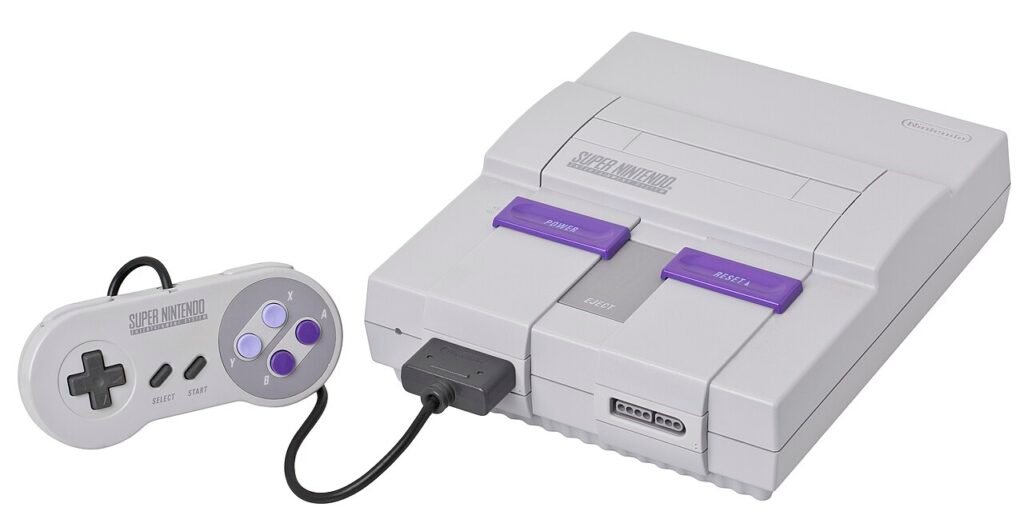
Super Nintendo (1991): the answer from Nintendo
The Super Nintendo reached North America on August 23, 1991, at $199.99 with Super Mario World in the box. The Christian Science Monitor reported in January 1992 that Nintendo said it had sold 2.1 million of them in four months and held about 60 percent of the 16-bit market. The console’s price in today’s money is about $493.30, as we show on the Super Nintendo price page.
PlayStation (1995): the $299 surprise
The most famous moment of the decade came at the first E3 trade show in May 1995. Sega had just said that its Saturn would cost $399. Sony’s Steve Race then walked on stage and said “$299”. The PlayStation went on sale in North America on September 9, 1995. It is worth reading about the PlayStation launch price to see how much that single figure mattered. In today’s money, $299 from 1995 is about $657.60.
Nintendo 64 (1996): 3D arrives in the living room
The Nintendo 64 launched in the United States on September 29, 1996, at $199.99. Nintendo had originally planned a higher price, but the PlayStation and the Saturn had both dropped to $199.99 by that summer. Its three-pronged controller and its analogue stick set the pattern for how people steered characters in 3D worlds. The Nintendo 64 launch price page has more.
Game Boy and Game Boy Color: the handheld that would not go away
The original Game Boy arrived in North America in 1989 at under $100 and kept selling through the whole decade. PBS reported that Nintendo sold 40,000 units on the first day in North America. The Game Boy Color followed on November 18, 1998 at $79.95, which you can read about on the Game Boy Color launch price page. Together they showed that a cheap, durable and simple machine could outsell more powerful rivals.
Sega Dreamcast (1999): the last console from Sega
The Dreamcast went on sale in the United States on September 9, 1999 at $199, with 18 games available on the first day. CNN Money described that as the most of any new console. It had a built-in modem and was far ahead of its time for online play, but it was overtaken by the PlayStation 2, which reached the United States in October 2000. Sega stopped making consoles in 2001.
What the 1990s consoles cost in hours of work
Prices alone can be misleading, so it helps to compare them with pay. At the federal minimum wage of $4.25 an hour that applied in 1995 and 1996, a $299 PlayStation took about 70 hours of work and a $199.99 Nintendo 64 took about 47 hours. By the time the Dreamcast launched, at a minimum wage of $5.15, its $199 price equalled about 39 hours. Minimum-wage figures are only a guide, because most households earned more, but the pattern is clear: consoles got steadily easier to afford across the decade.
Play it yourself
If you would like to test your own sense of what things cost in the past, try the free daily price-guessing game on Price Time Machine. Each day you guess the launch price of a famous product, and you can challenge your friends to beat your score.
Questions about iconic gaming consoles of the 1990s
Which console was the best-selling of the 1990s?
The PlayStation, which went on sale in North America on September 9, 1995, was one of the decade’s biggest sellers. Sales figures differ between sources, so check the original company reports before quoting a specific total.
How much did a Super Nintendo cost in 1991?
The Super Nintendo launched in North America at $199.99 on August 23, 1991, with Super Mario World included.
How much did the Sega Dreamcast cost?
The Dreamcast cost $199 when it went on sale in the United States on September 9, 1999.
Why did the PlayStation win the console war of the 1990s?
Sony undercut the Sega Saturn on price at E3 in May 1995, with a $299 announcement against the Saturn’s $399, and it also attracted well-known game developers.
Related guides
- The evolution of video game consoles
- 10 toys that defined the 1990s
- The most expensive products of the 1990s compared with today
Sources
- Christian Science Monitor: Video-Game Wars Part II: The Battle for Awareness (31 January 1992)
- CNN Money: Sega kicks off next-gen console wars (9 September 1999)
- PBS NewsHour: Nintendo’s Game Boy turns 25
- Wikipedia: PlayStation (console)
- US Department of Labor: History of federal minimum wage rates
- US Bureau of Labor Statistics: Consumer Price Index (CPI-U)