How to Play Price Time Machine
Here is how to play Price Time Machine, a free daily history game about real launch prices. Each round shows a famous product, from a 1950s toy to the latest games console. You guess how much it cost when it first went on sale (and, in Expert mode, where it comes from), then see what that price would be in today’s money. Think of it as a nostalgia quiz with a world map and an inflation calculator built in.
Two ways to play: Classic and Expert
Before your first game you choose how you want to play. You can switch at any time with the Classic / Expert switch at the top of the game.
| 💰 Classic | 🌍 Expert | |
|---|---|---|
| What you guess | The launch price | The launch price and where it came from |
| The map | No map | Pin it on the globe (or a flat map) |
| Points per round | Up to 1,000 | Up to 2,000 |
| Daily challenge | Out of 10,000 | Out of 20,000 |
| Leaderboard | Classic leaderboard | Expert leaderboard |
Classic is the quickest way in: perfect if you just love guessing prices. Expert adds the geography round for twice the points. Each mode has its own daily challenge attempt and its own leaderboard, so Classic and Expert players are only ever ranked against each other’s mode.
How to play a round
- Meet the product. You see its name, the year it launched and a short description.
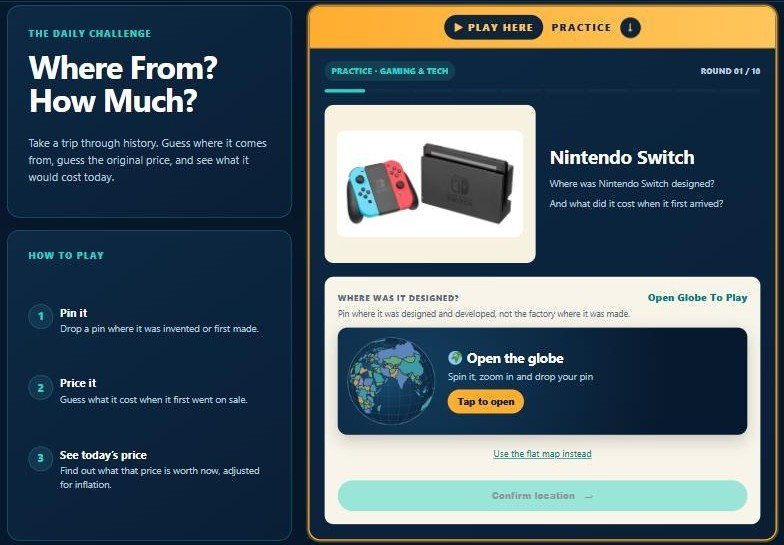
- Drop your pin (Expert only). In Expert mode every round starts with a globe: spin it, zoom in and drop your pin. Each round tells you exactly what to pin, such as where the product was invented, designed, first made or first sold. Prefer a flat map? There’s a switch for that.
- Guess the launch price. Slide to the price you think it cost when it first went on sale, in US dollars.
- The reveal. We show the real launch price, what it would cost today adjusted for inflation, and (in Expert) how far your pin was from the real place.
A game is 10 rounds, and you see your score at the end.
How scoring works
In Classic, each round gives you one score out of 100%: your price accuracy. In Expert, every round gives you two: one for your price and one for your pin. They count equally, so a great pin can rescue a bad price guess, and the other way round.
Price accuracy
This depends on how far out you are in percent, not in dollars. Being $10 out on a $20 toy counts the same as being $5,000 out on a $10,000 car. Get within 2% of the real launch price and you score full marks.
| Your guess is… | Price accuracy |
|---|---|
| within 2% | 100% |
| 5% out | 90% |
| 10% out | 81% |
| 25% out | 56% |
| 50% out | 25% |
| double the price, or more | 0% |
Location accuracy (Expert)
This depends on how many kilometres your pin lands from the real place. It drops off smoothly, so being a few hundred kilometres out still scores well, while the wrong continent scores very little.
| Your pin is… | Location accuracy |
|---|---|
| spot on | 100% |
| 100 km away | 94% |
| 500 km away | 72% |
| 1,000 km away | 51% |
| 2,000 km away | 26% |
| 5,000 km away | 4% |
The right-country safety net (Expert)
Small countries are hard to hit, especially on a phone. So if your pin lands inside the right country, or in the sea within 100 km of its coast, your location accuracy is at least 80%, however far you are from the exact spot. A closer pin still scores more. You’ll see “✓ Right country” on the reveal when the safety net kicks in.
Your score
Your accuracy is averaged over the game and turned into points. In Classic, each round is worth up to 1,000 points for the price, so the 10-round daily challenge is out of 10,000: 80% accuracy scores 8,000. In Expert, your price and location accuracy are combined, and each round is worth up to 2,000 points (1,000 for the price and 1,000 for the pin), so the daily challenge is out of 20,000: 80% combined accuracy scores 16,000.
Inflation then and now: how today’s price is worked out
We show launch prices in US dollars, as the product first sold in the United States. To turn a historical price into today’s money we use the US Consumer Price Index (CPI-U) from the US Bureau of Labor Statistics. We compare the price level in the month the product launched with the latest month the Bureau has published, and scale the launch price by the same amount. If we only know the launch year, we use that year’s average instead. The reveal shows exactly which months are compared, and we update today’s prices every week as new figures come out.
This is the standard way to compare prices adjusted for inflation. It tells you what the same amount of money would buy today, which is not always what the product would sell for now. A 1980s home computer that cost a fortune then would be worth far less second-hand today, but its launch price shows how big a purchase it really was.
The daily challenge and the leaderboard
Every day at midnight UTC there’s a new daily challenge: 10 questions from every category, the same for everyone. You get one ranked attempt in each mode, so you can play it once in Classic and once in Expert. Your first attempt in each mode is the one that counts. You can replay it afterwards for fun, but replays don’t change your score.
A free account saves your scores and puts you on the daily, weekly and all-time leaderboards. There are two sets of leaderboards, one for Classic and one for Expert: use the tabs above the rankings to switch. Your all-time rating in each mode is your average accuracy over your last 20 daily challenges in that mode (you need 3 to be placed). It puts you in a division, from Bronze, Silver, Gold and Platinum up to Diamond, and gives you a world ranking.
Practise by category
Want to warm up first? The best way to learn how to play is a practice game. Pick a category for a practice game of random questions from it. Practice games are just for fun and don’t count towards the leaderboard.
Play today’s daily challenge →
Tips for better guesses
- Think about the launch year, not today. A pocket calculator in the early 1970s cost a small fortune.
- New technology usually launches expensive and gets cheaper. Snacks and drinks start cheap and creep up with inflation.
- Watch the scale: houses and cars run into thousands of dollars, a chocolate bar into cents.
- Read the map question carefully. “Where was it designed?” and “Where was it first made?” can have different answers: the DeLorean was styled in Italy, engineered in England and built in Northern Ireland.
- Your dashboard shows your strongest and weakest categories, so you know what to practise.
Frequently asked questions
About the game
What’s the difference between Classic and Expert?
Classic is price only: you guess what each product cost when it first came out, for up to 1,000 points a round. Expert adds a map round: you also pin where the product came from, for up to 2,000 points a round. Each mode has its own leaderboard.
Can I switch modes or play both?
Yes. Use the Classic / Expert switch at the top of the game at any time. The daily challenge has one ranked attempt in each mode, so you can play it once in Classic and once in Expert every day.
Do challenge links use the same mode?
Yes. When a friend sends you their score card link, you play the same questions in the same mode they played, so the scores are a fair comparison.
Is Price Time Machine free?
Yes. It’s free to play in any web browser, on a phone, tablet or computer, with nothing to download. A free account is optional; you only need one to save your scores and join the leaderboard.
What does the map pin mark?
Many products were invented, designed, made and first sold in different places, so every round says which one to pin: where it was invented, where it was designed, where it was first made or built, where it was first sold (for example the first restaurant), or where the company behind it was based. After you pin, we show the real place with a short explanation, including other places linked to the product.
About the prices
Why are all prices in US dollars?
So every product can be compared on the same footing. Launch prices are the US launch price in dollars, and today’s prices use US inflation.
How do you work out what it would cost today?
We adjust the launch price for inflation using the US Consumer Price Index (CPI-U) from the US Bureau of Labor Statistics, comparing the launch month with the latest month the Bureau has published (or the launch year’s average if we only know the year).
Where do the launch prices come from?
We research each launch price from sources from the time, such as original adverts, catalogues, press releases and news reports. Then we check every question by hand before we publish it. If you spot one that looks wrong, please let us know.
About scoring
How are points worked out?
Each round gives a price accuracy (how far out your guess was, in percent) and a location accuracy (how far your pin was from the real place, in kilometres). They count equally. Your combined accuracy over the game sets your score: each round is worth up to 2,000 points, so 80% accuracy over 10 rounds scores 16,000. In Classic, only the price counts: each round is worth up to 1,000 points, so 80% accuracy over 10 rounds scores 8,000.
I pinned the right country. Why didn’t I get 100%?
Being in the right country guarantees at least 80% location accuracy. Full marks still go to a pin on the exact place, so in a big country like the United States a pin on the right city scores more than one on the other coast.
My pin was just off the coast. Does it still count?
Yes. A pin in the sea within 100 km of the right country’s coast counts as the right country, so it gets at least 80% location accuracy.
About the daily challenge
When does the daily challenge change?
At midnight UTC. That’s midnight in the UK in winter and 1am in summer.
Can I play the daily challenge more than once?
You can replay it for fun, but only your first attempt counts for the leaderboard.